Inspiration
A Day with Jean-Charles de Castelbajac
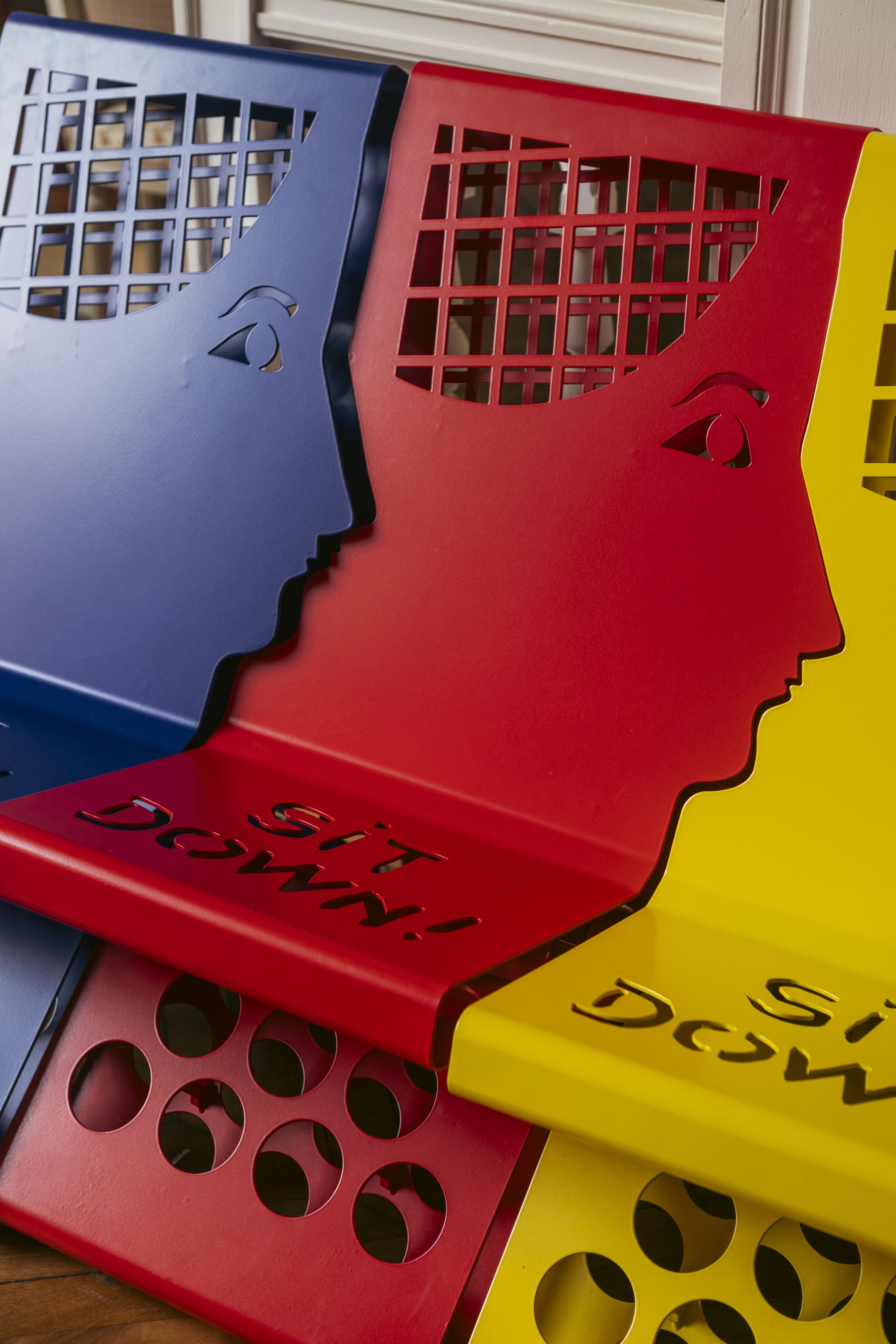
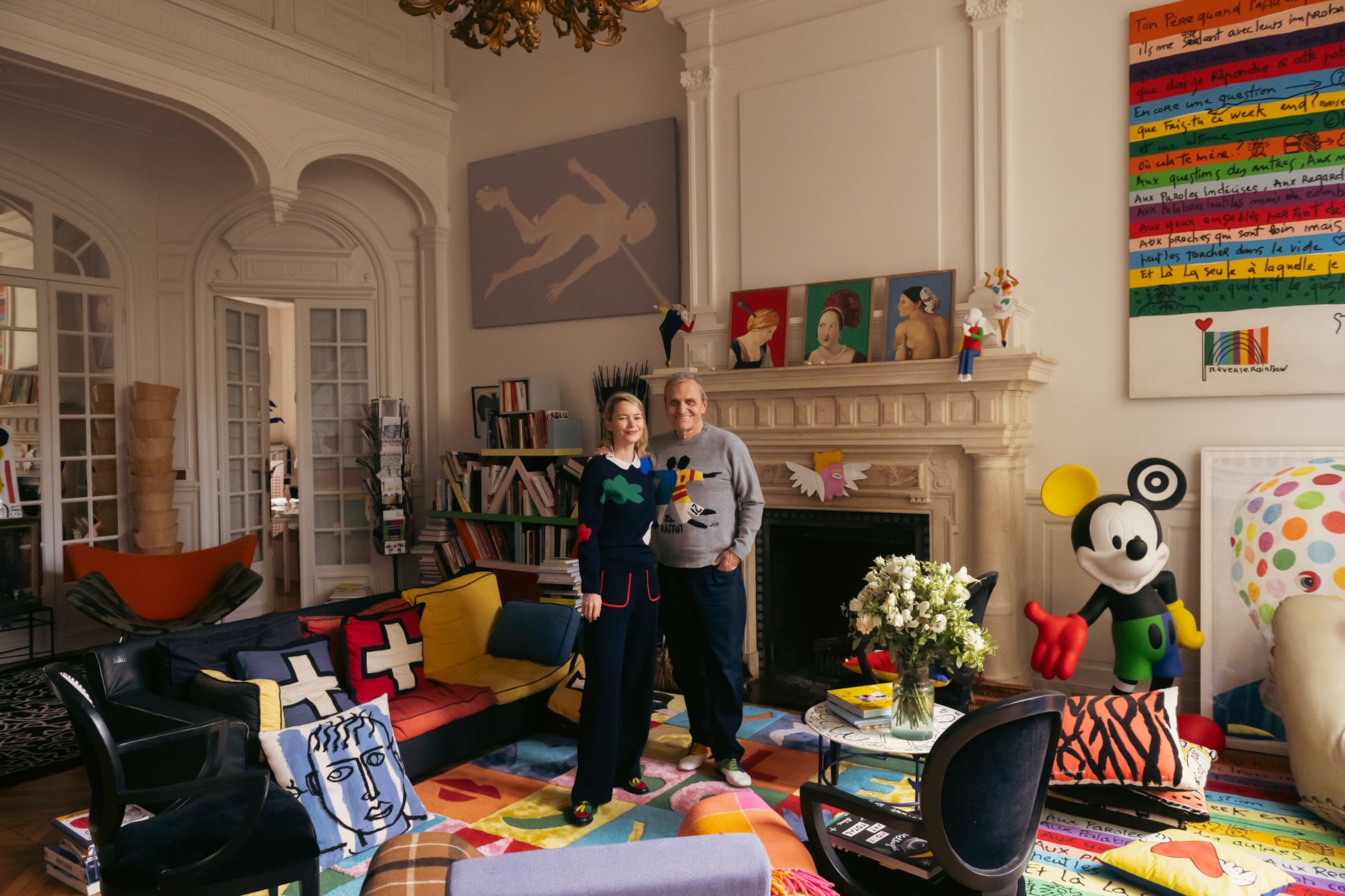
A prolific artist, Jean-Charles de Castelbajac has moved from project to project and collaboration to collaboration since the 1970s, whether in fashion, with Weston, Max Mara, Aigle or K-Way, or in design, with houses such as Fermob, Gien or the Manufacture des Émaux de Longwy. His next venture will be with Galeries Lafayette, whose spaces he will take over for Christmas 2026. His work spans performances at the Palais de Chaillot, projects with young designers (Hall Haus), and collaborations with artists, both those invited to design the invitations to his fashion shows (Keith Haring, Cindy Sherman) and those who have worked on his “painting dresses” (Miquel Barceló, Ben, Robert Combas). It extends to the creation of liturgical garments and ornaments for the reopening of Notre-Dame de Paris. His teeming universe never stops reinventing itself, erasing the boundaries between fashion, art and design.
He says he wants to “upcycle history and renew the way generations look at one another,” and he has never stopped drawing on childhood as an essential source of inspiration. With his primary colors of red, blue and yellow, which have become his signature, he has shaped an instantly recognizable visual language, nourished by pop culture, freedom and imagination, which spans the decades without losing any of its freshness or brilliance.
The major retrospective devoted to him, L’Imagination au pouvoir, closed at the Abattoirs in Toulouse last August, and his first monograph will soon be published (by Éditions du Chêne). With this in mind, we wanted to knock on the door of his studio and spend some time with this singular personality, to discover the objects, artworks and ideas that fill his daily life, and to understand what still drives, even today, his insatiable desire to create.
Location
Paris
Author
Johanna Colombatti
Photos and videos
Valerio Geraci, Gautier Billotte
TSF
Jean-Charles, we’re here in your studio. Could you tell us a little bit about yourself?”
Jean-Charles de Castelbajac
“It’s never an easy question to answer, but I would say that I’m a multidisciplinary artist. Fashion has been, and still is, my favourite medium, because I see it as a kind of binding force, a vehicle, something that brings everything together. It’s Christmas time, after all: fashion is like the ribbon that wraps everything up — the connection that ties it all together.
I learned everything through fashion. I learned about performance through fashion shows, about installation through window displays, and about curation, because throughout my career, I’ve brought together artists I wanted to work with: Xavier Veilhan for my sets, Toscani for my campaigns… There have been hundreds of them.
I would also say that I learned about scenography, because a fashion show is something that reminds me of what Laurie Anderson describes in one of her songs: ‘They all come into the same room, at the same time, and wait to see what’s behind the curtain.’ It’s about the ability to create mystery, to unsettle people, to provoke a sense of wonder.
And finally, I would say screenwriting, because over time, you write a style, you build an identity, and you become aware of the power a message can have when it is conveyed through style.”
TSF
How did you find your way into the world of creativity ?
Jean-Charles de Castelbajac
I came to creativity in a rather unconscious way, at a very early age, because I had a particular affection for the little things in life. I loved bits of string, pebbles by the side of the road… There’s a Bécassine story like that, where she falls in love with a pebble and wants to protect it from people walking over it. I was a little like that.
I also loved eucalyptus bark, which I would carve into little boats. I had a bit of a MacGyver mentality: the ability to make something out of almost nothing. This sensitivity to the little things came from various experiences, particularly solitude — first, the solitude of boarding school, where I spent eleven years. Then perhaps there was my encounter with a rather esoteric world in the Limousin region, where occult traditions existed and where I discovered very unusual, peculiar objects. Objects that would later remind me of Tàpies or the Arte Povera movement. But everything I loved was poor, humble, and I didn't yet know that it was art.
Above all, my mother owned a ready-to-wear clothing company in Limoges, called KO & CO. When I was seventeen, she introduced me to the process of designing and constructing a garment. We went on to form a wonderful creative partnership that lasted twenty years.
So, there I was, already equipped with a few tools from a very early age.
But the most powerful weapon came when the flint stone that represented my childhood collided with another flint stone, one that represented rock 'n' roll.
TSF
How long has this studio been around ?
Jean-Charles de Castelbajac
I've always had a studio. It has been the beating heart of my life.
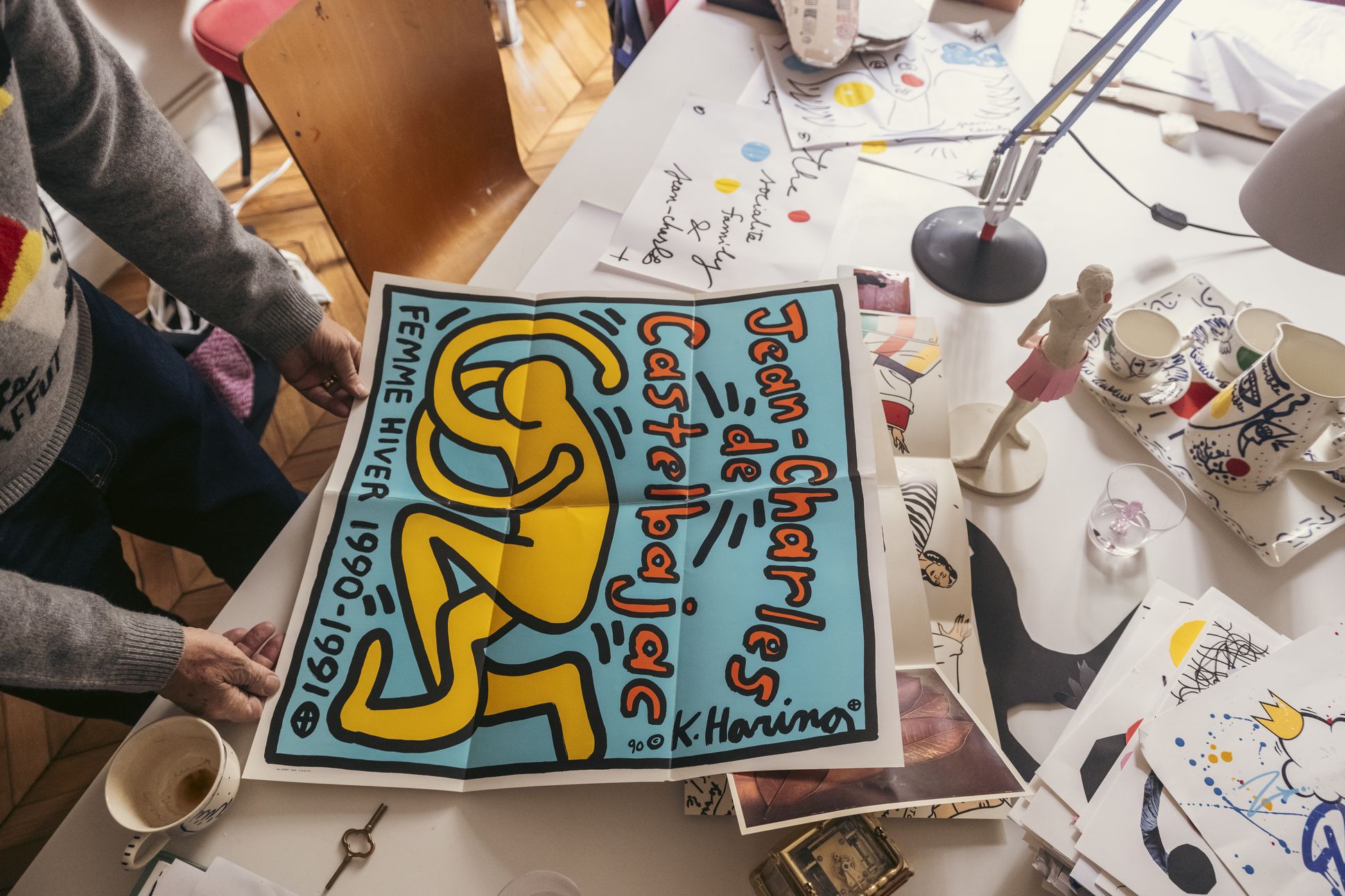
First and foremost, the studio is about community. I'm a people person, someone who thrives on being part of a group, so I've always needed a community around me. And when people didn't come to me, I'd go out and find them. That's how Malcolm McLaren, from the Sex Pistols, and I became friends. Later, there was Keith Haring, who came to me.
That's something I find a little frustrating about the world today: it seems we can no longer have a conversation or an exchange of ideas without things escalating into conflict, rather than giving rise to something new.
So, there was already this intellectual and emotional studio, which was like a family to me. And then there was always the creative core: bringing in assistants and artistic collaborators to work alongside me. I've had many assistants who were incredibly inventive and complemented my own approach.
Today, my studio is a small nucleus, almost like a rock band. It consists of Pauline, my wife, who manages collaborations; Anaëlle, my artistic assistant; and three archivists.
Then there are additional people who join the team depending on the project: designers, photographers, musicians… One musician in particular comes back regularly: Vladimir Cauchemar, with whom I've just created the Christmas soundtrack for Galeries Lafayette. He also composed the music for my exhibition L'Imagination au pouvoir at Les Abattoirs in Toulouse. Another is Julien Granel, who created the soundtrack for my 2021 exhibition Le Peuple de demain at the Centre Pompidou.
TSF
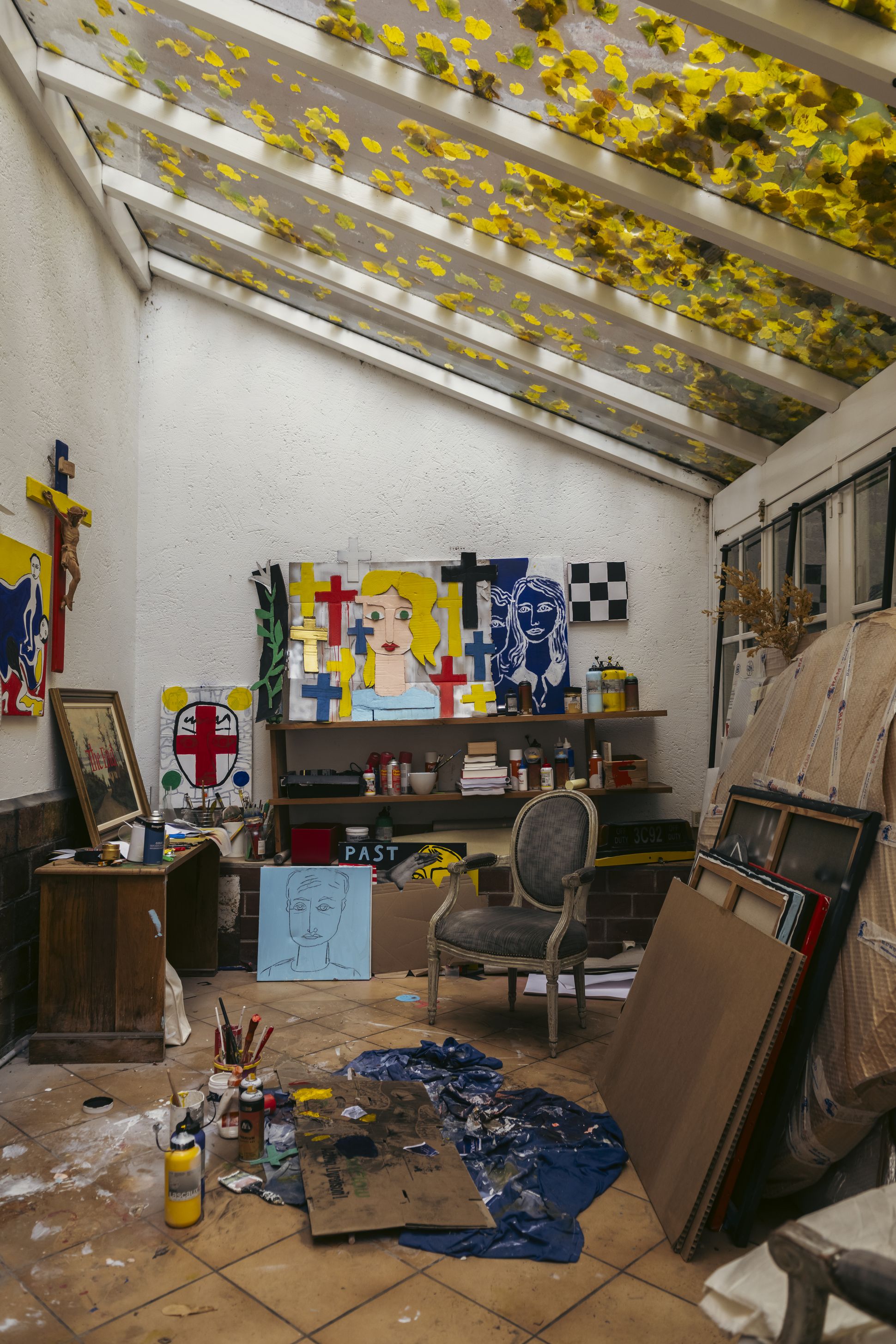
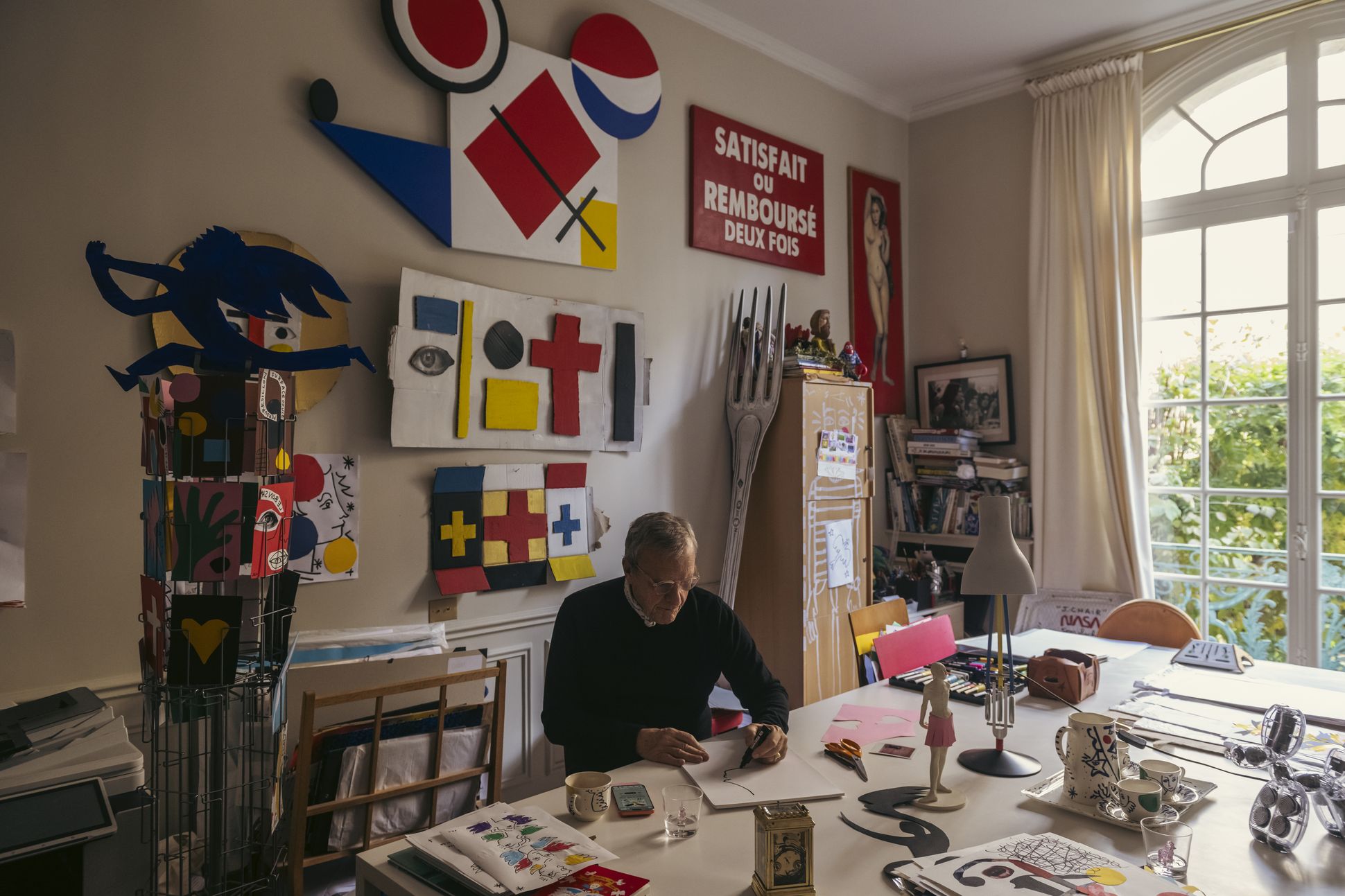
What does this space, your studio, consist of?
Jean-Charles de Castelbajac
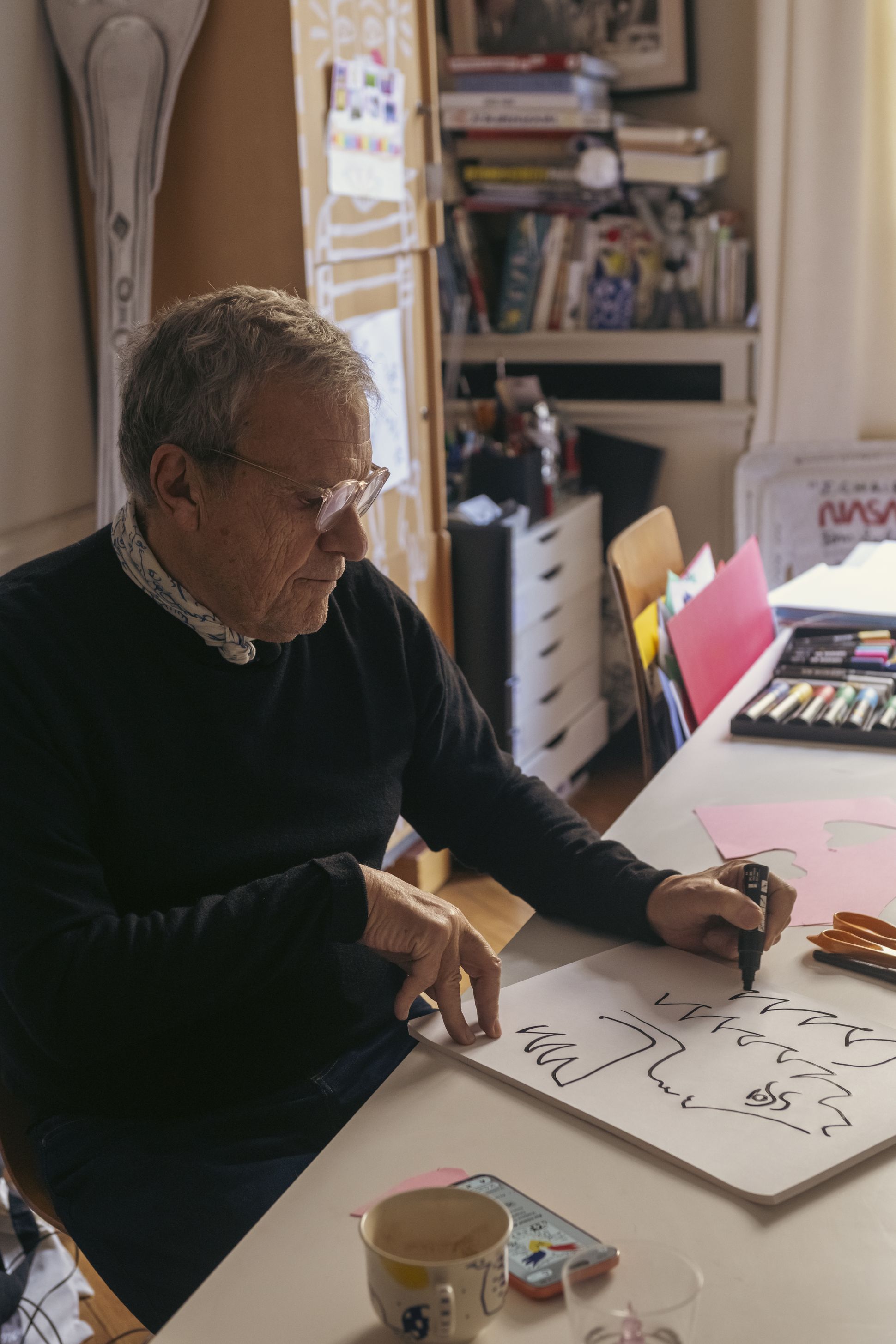
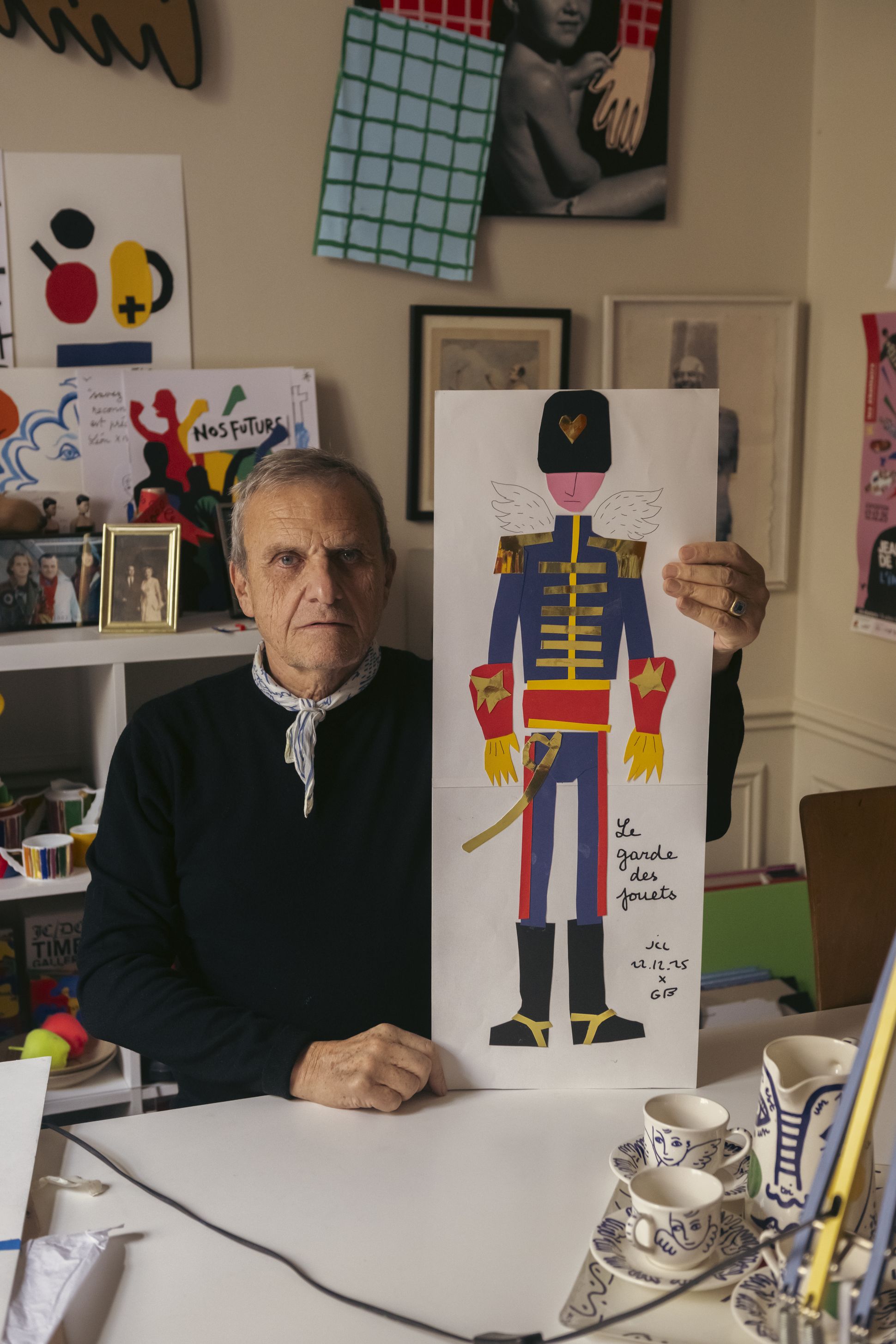
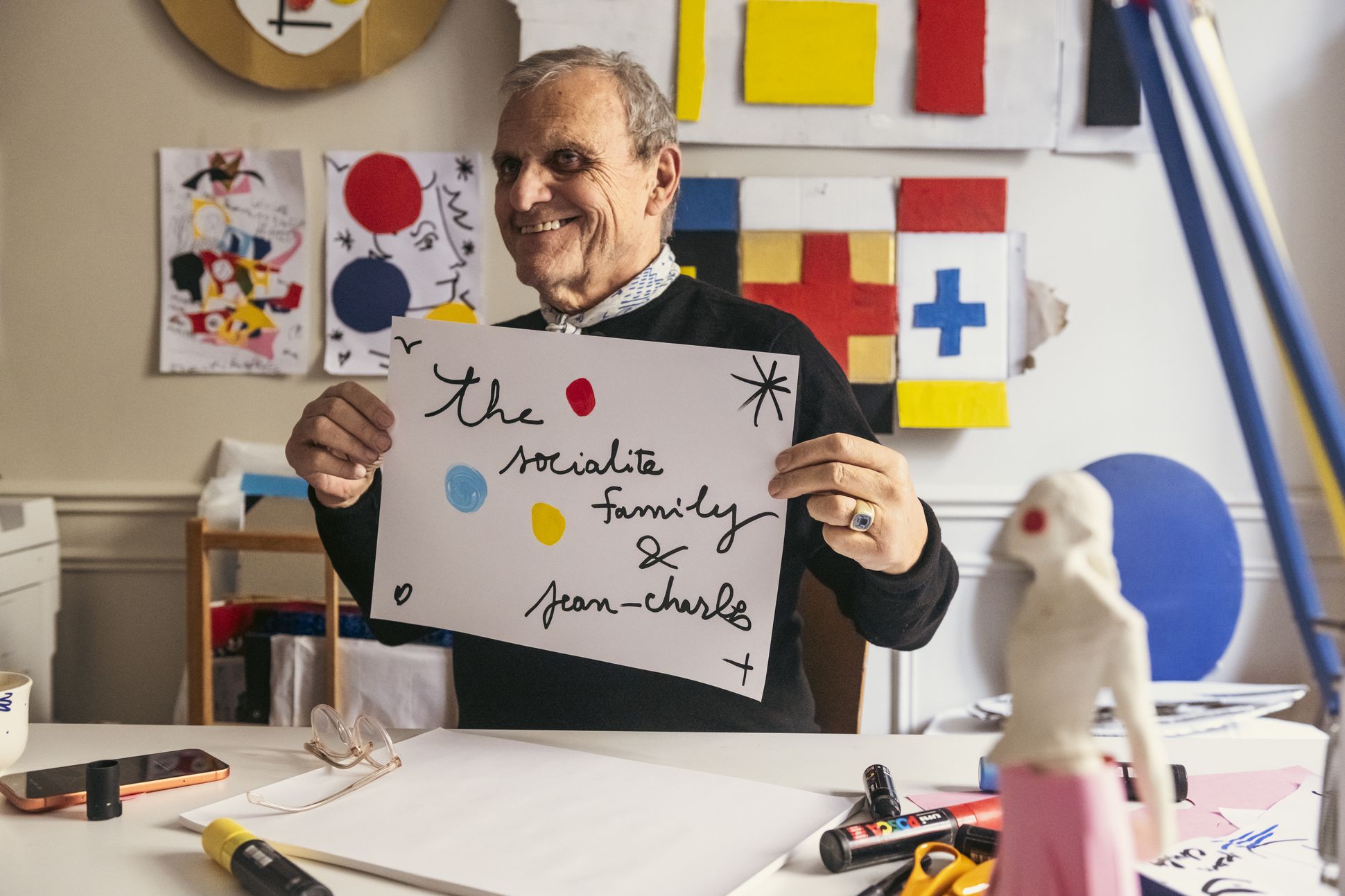
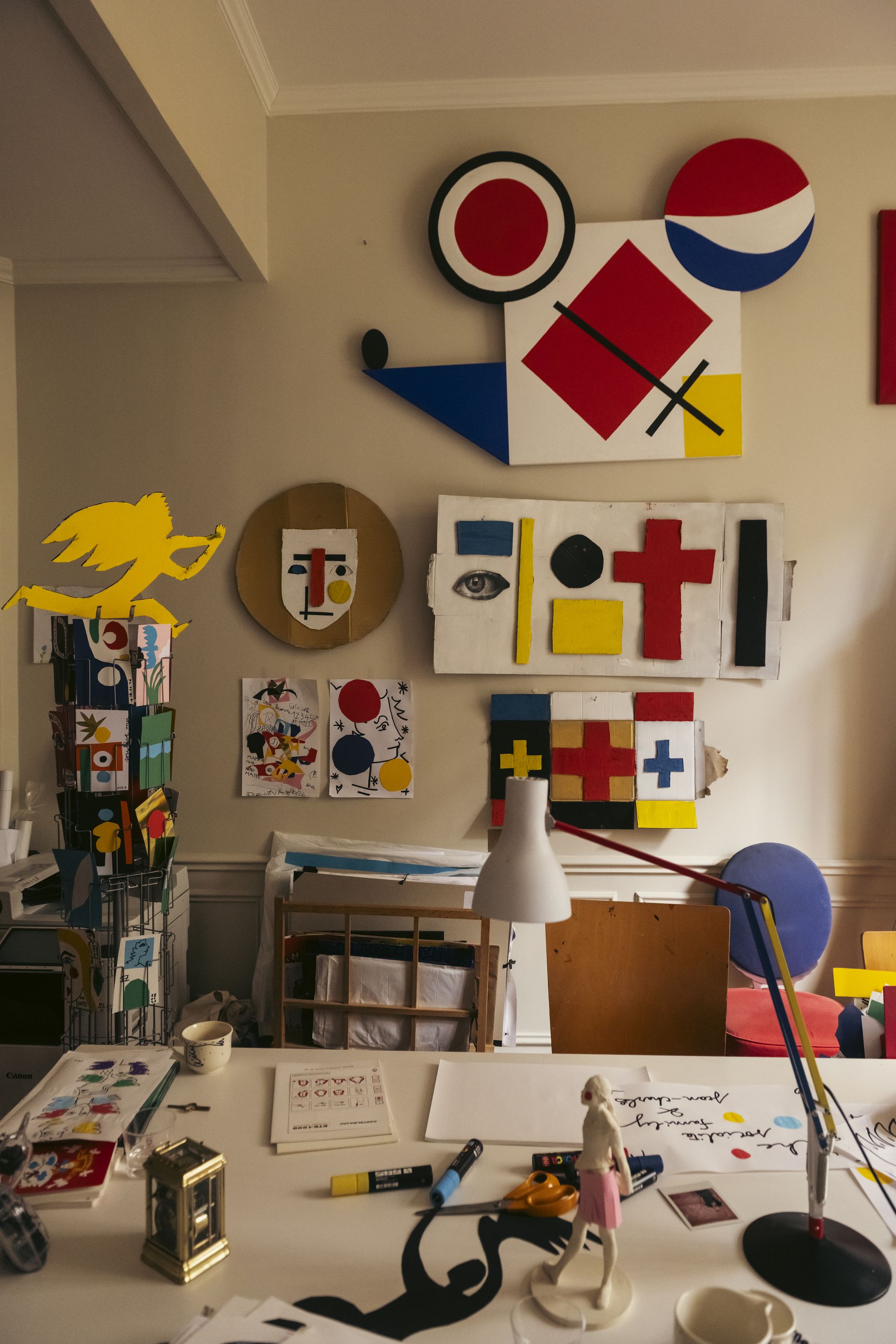
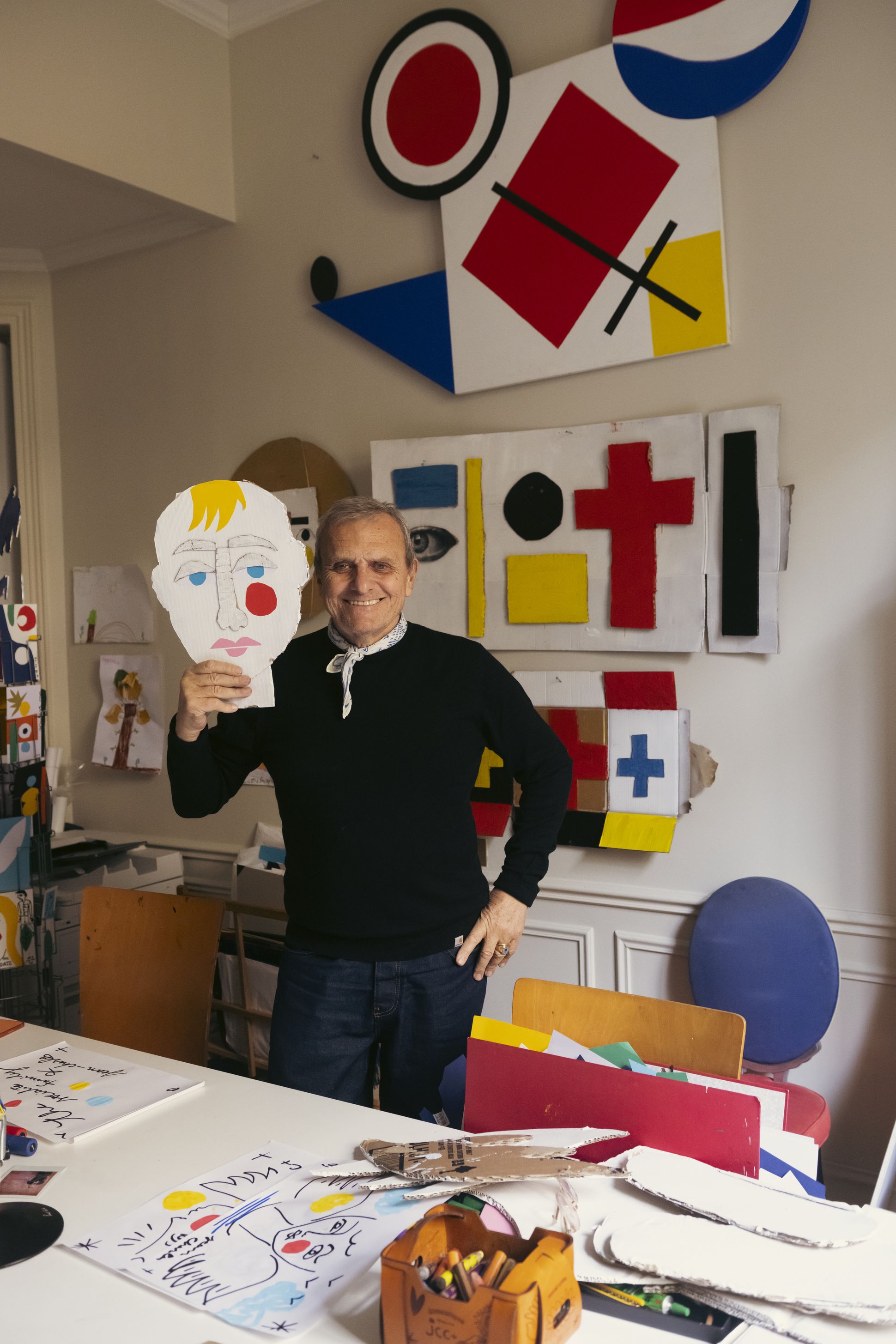
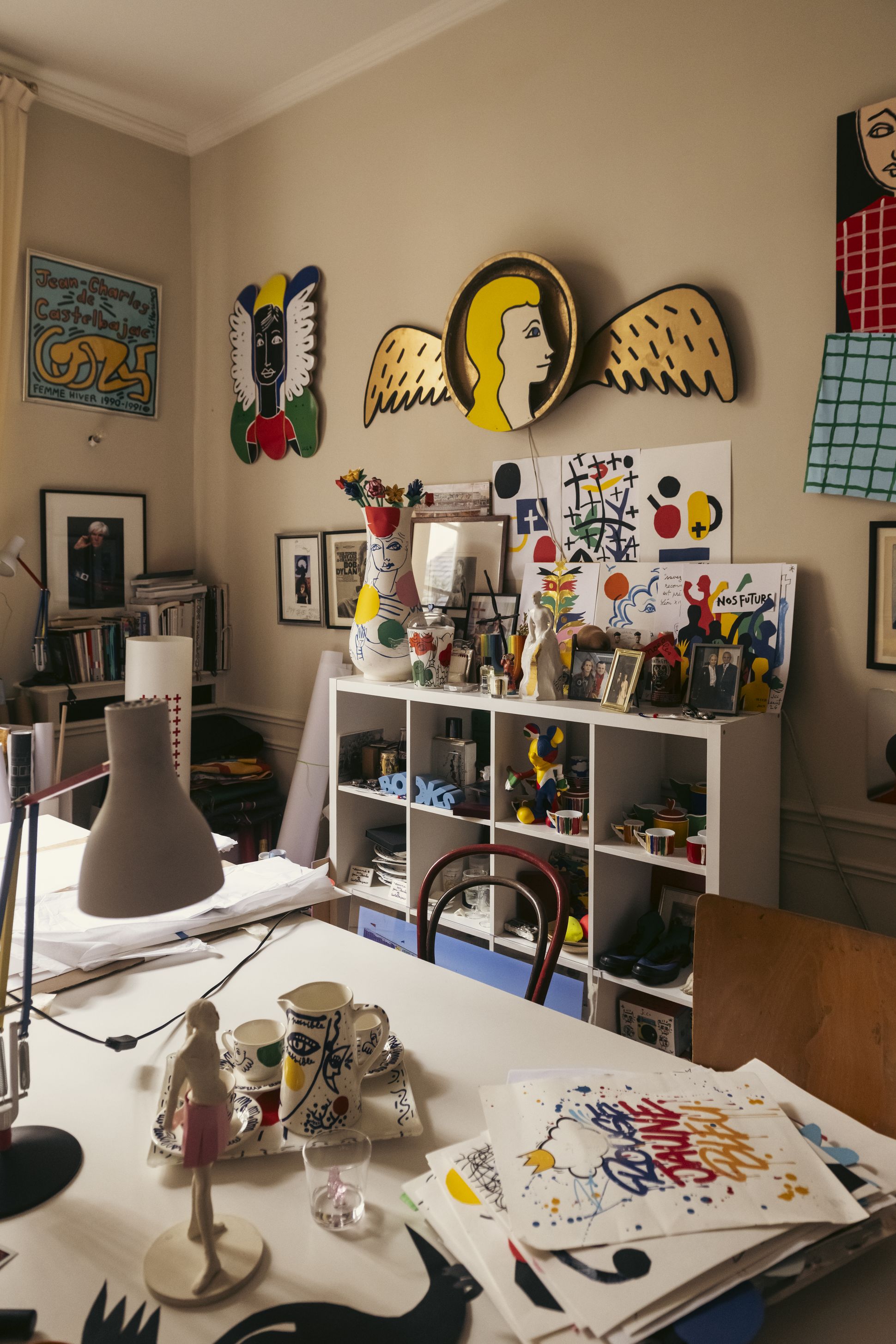
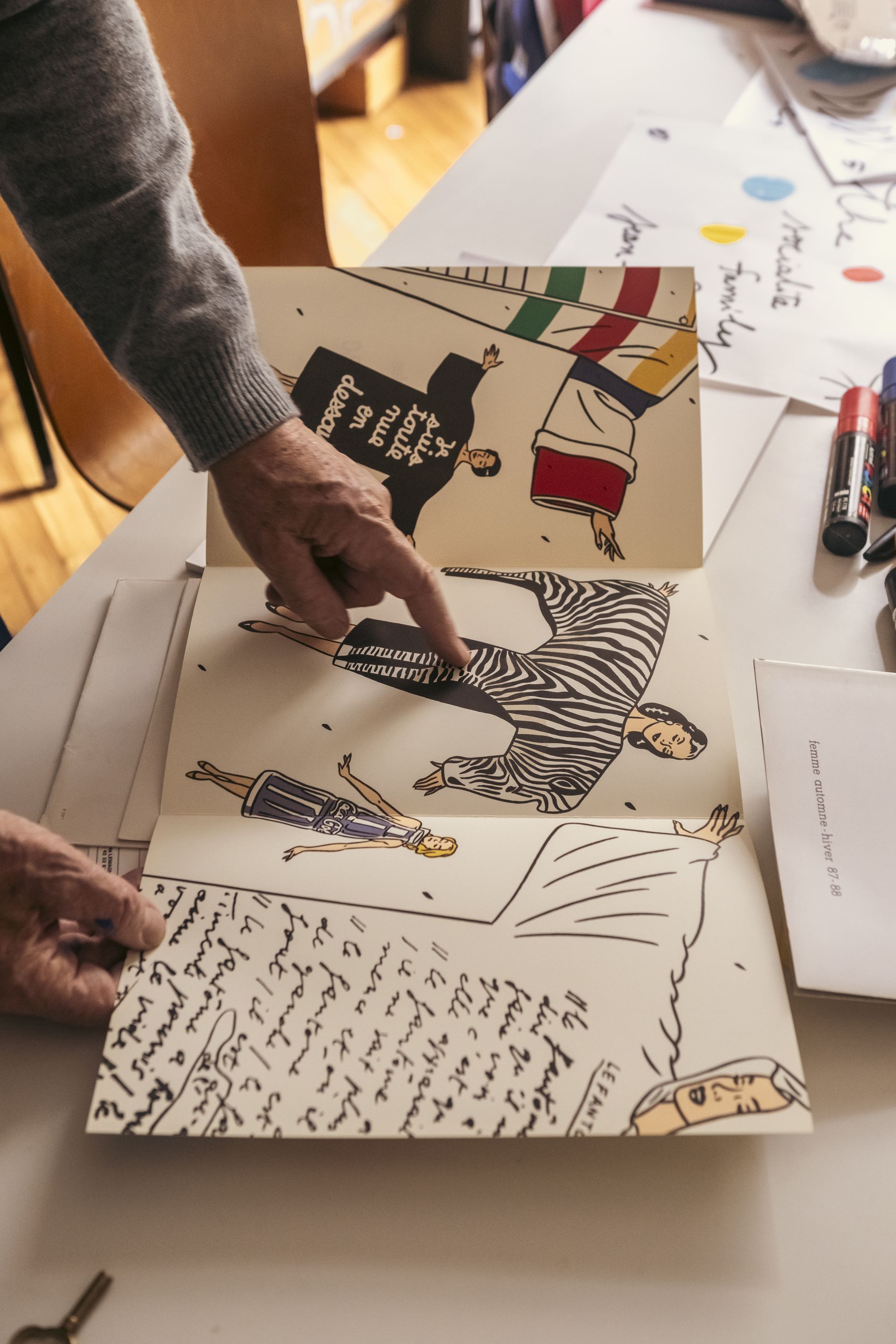
I have this aircraft carrier, which is the central table where I work. It's my favourite shape: the rectangle. It's the shape of blankets, flags, football pitches and tennis courts. It's my favourite shape.
And from this table, drawings take flight, along with ideas and concepts.
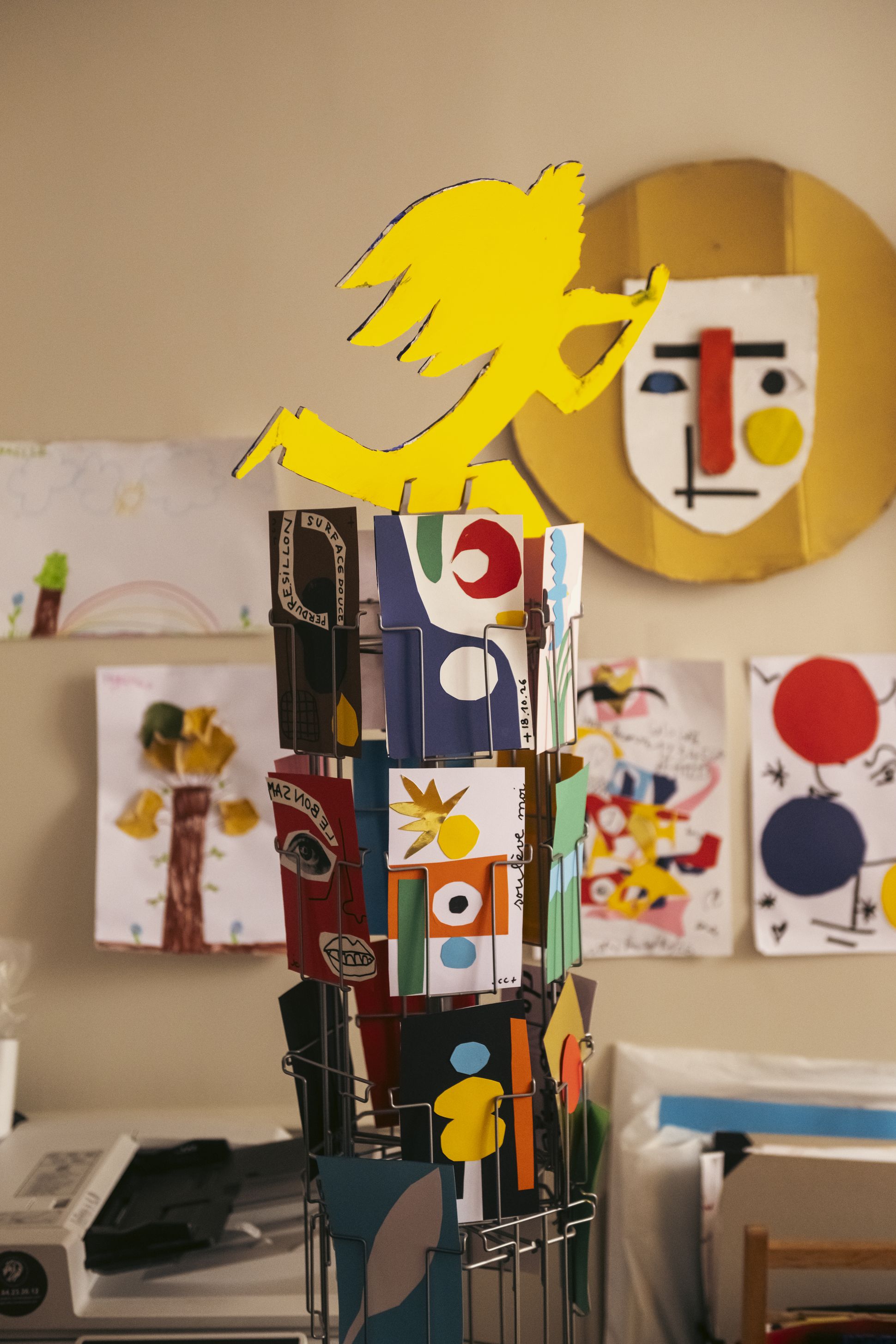
Then there's a revolving display stand, which is my favourite object. It's like a carousel of images. I've always loved this particular object. I'm just putting the finishing touches to this installation.
TSF
You are a collector and have been closely connected to many artists from the contemporary art scene. Are there any artworks or objects you would like to show us?
Jean-Charles de Castelbajac
I started collecting at a very early age. As a child, I collected toy soldiers, and later I began collecting flags.
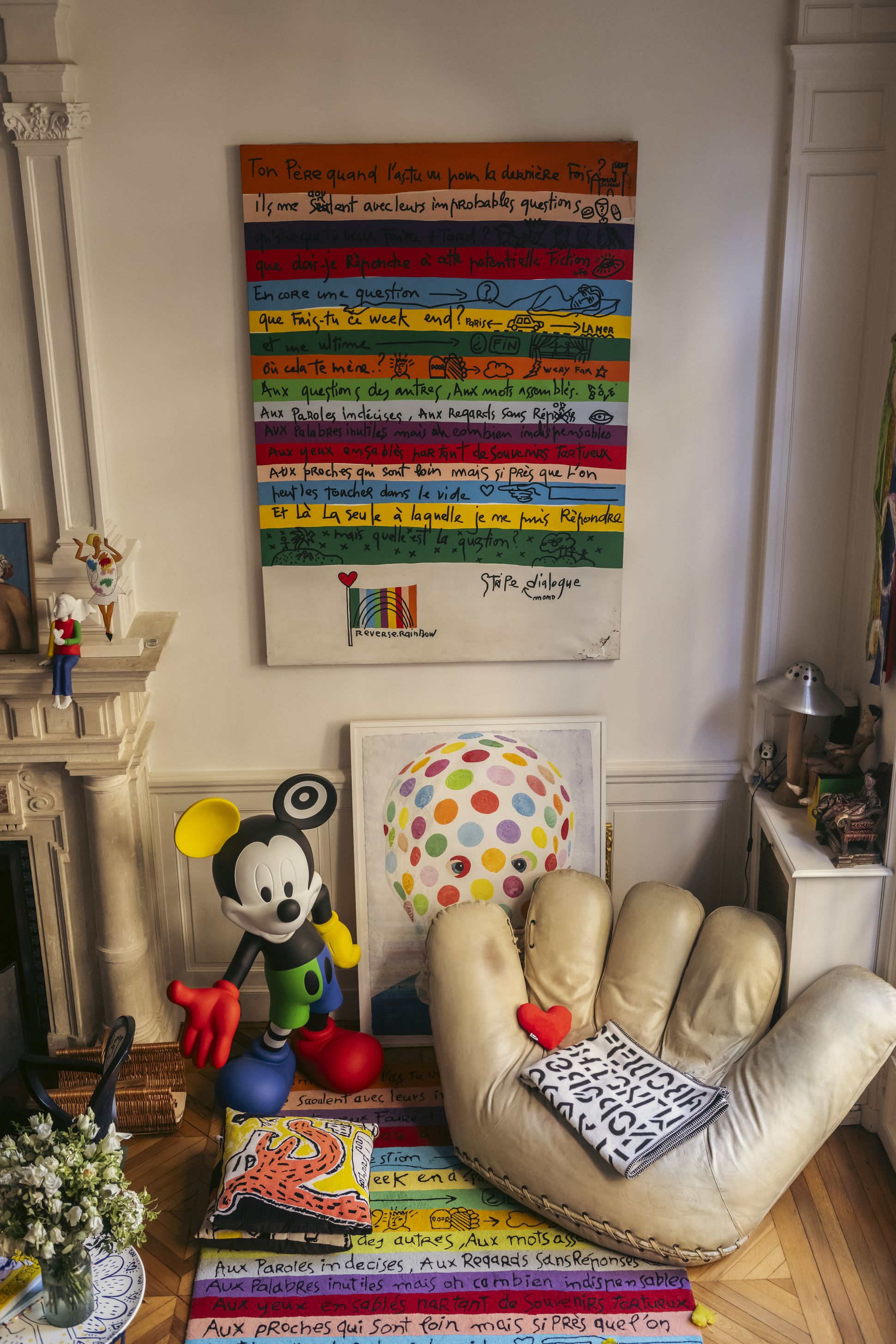
I've always felt that within this rectangle of fabric blowing in the wind lies something both heroic, epic and chivalrous, but also something that brings people together. In fact, it's a metaphor for my clothes. I've always wanted them to offer protection, to tell a story, and to catch the wind.
In the past, I was also a passionate collector of contemporary art and vintage photography, which led me to collaborate with some great photographers, such as Mapplethorpe, Peter Hujar and Bettina Rheims.
I think it's history that has influenced my work. Not the history of fashion, but History itself — its very foundations.
TSF
How do you arrange the setting in which you live?
Jean-Charles de Castelbajac
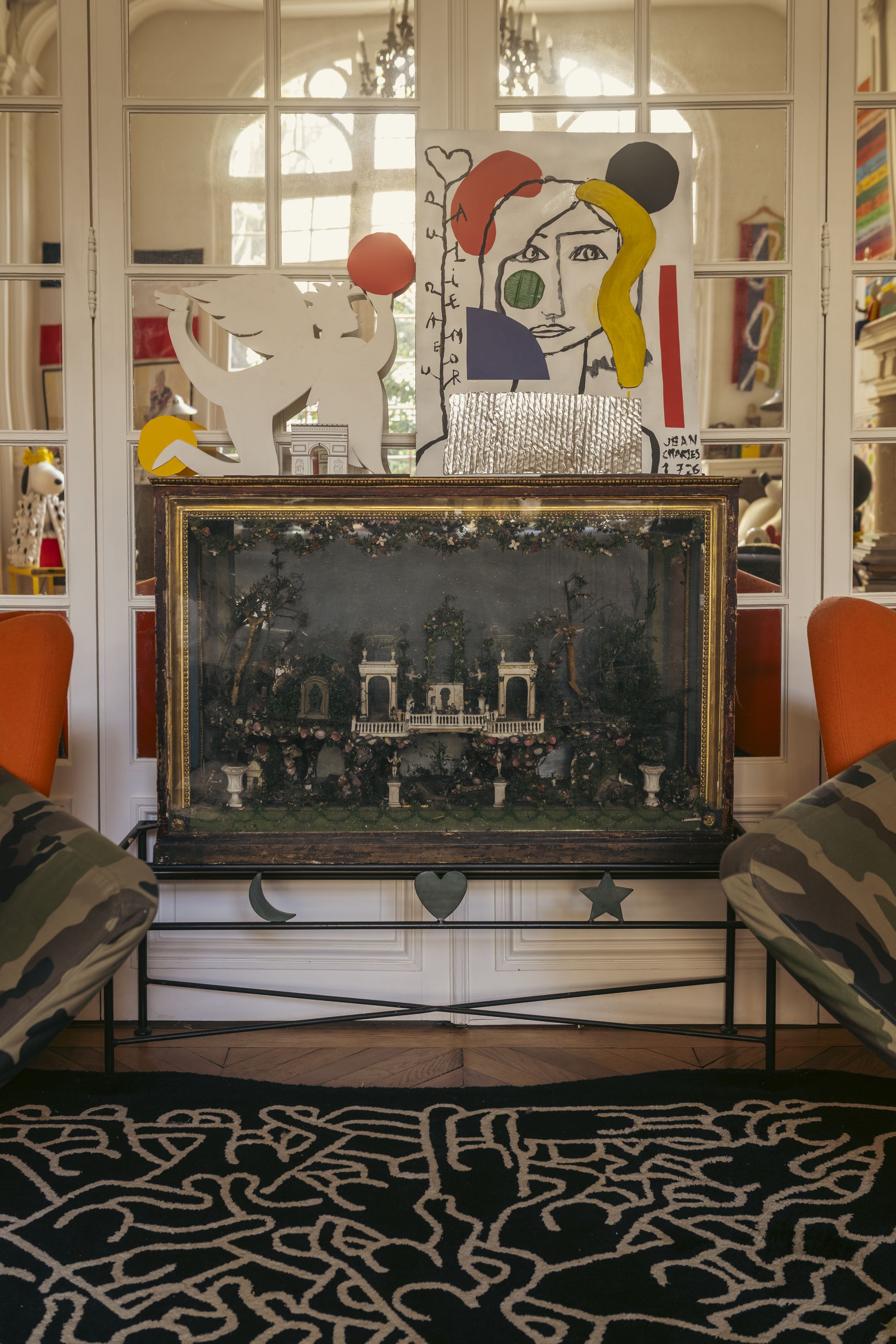
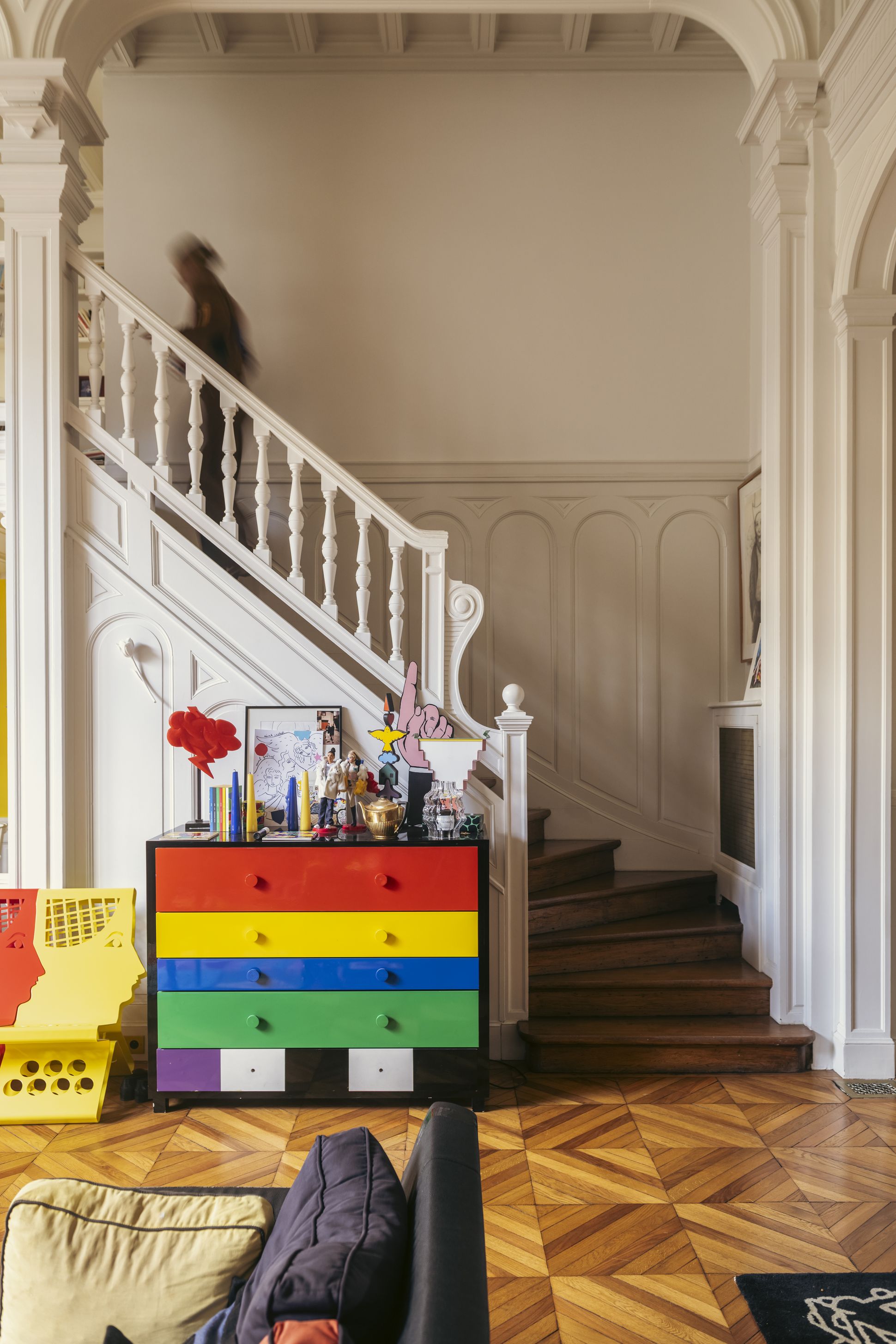
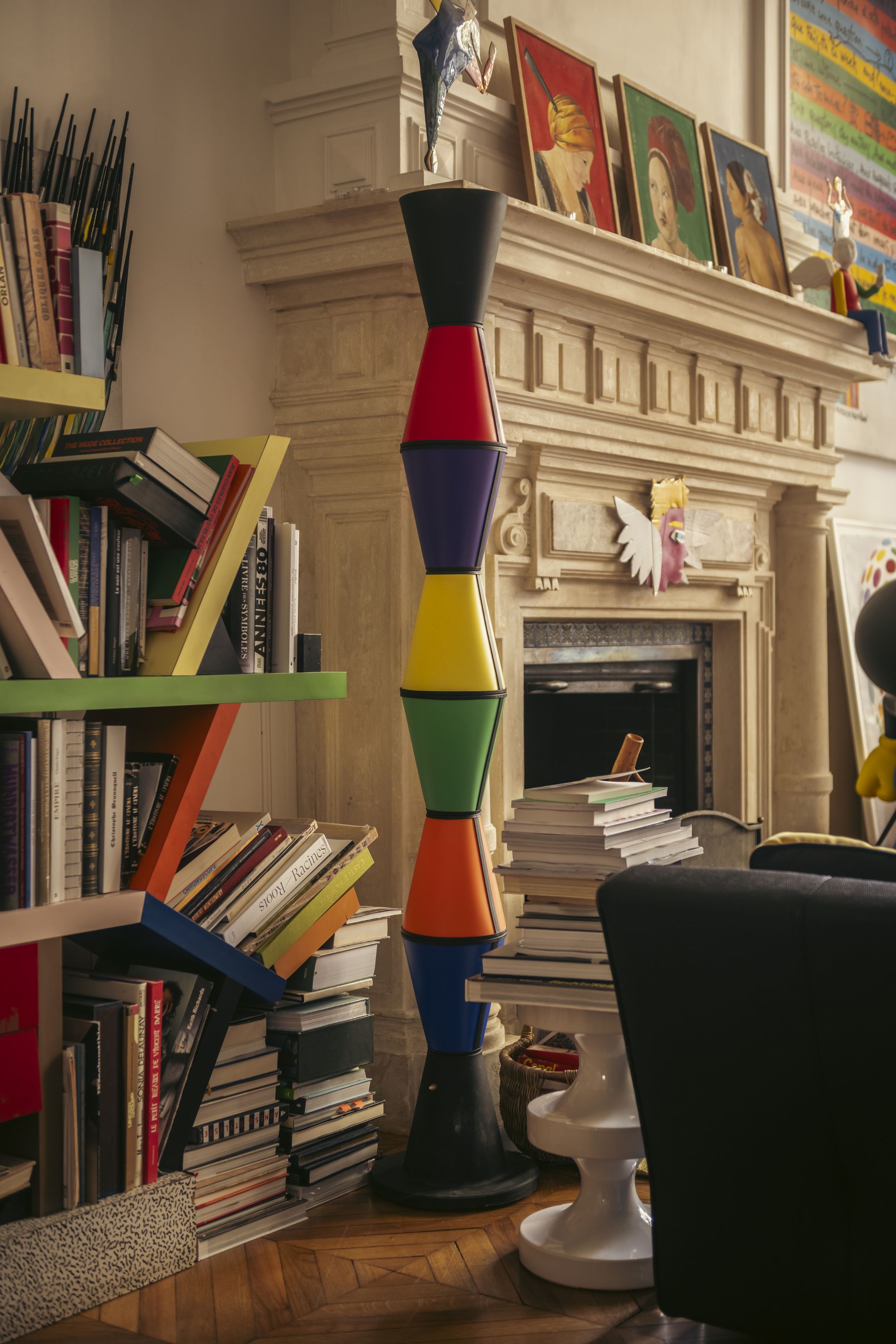
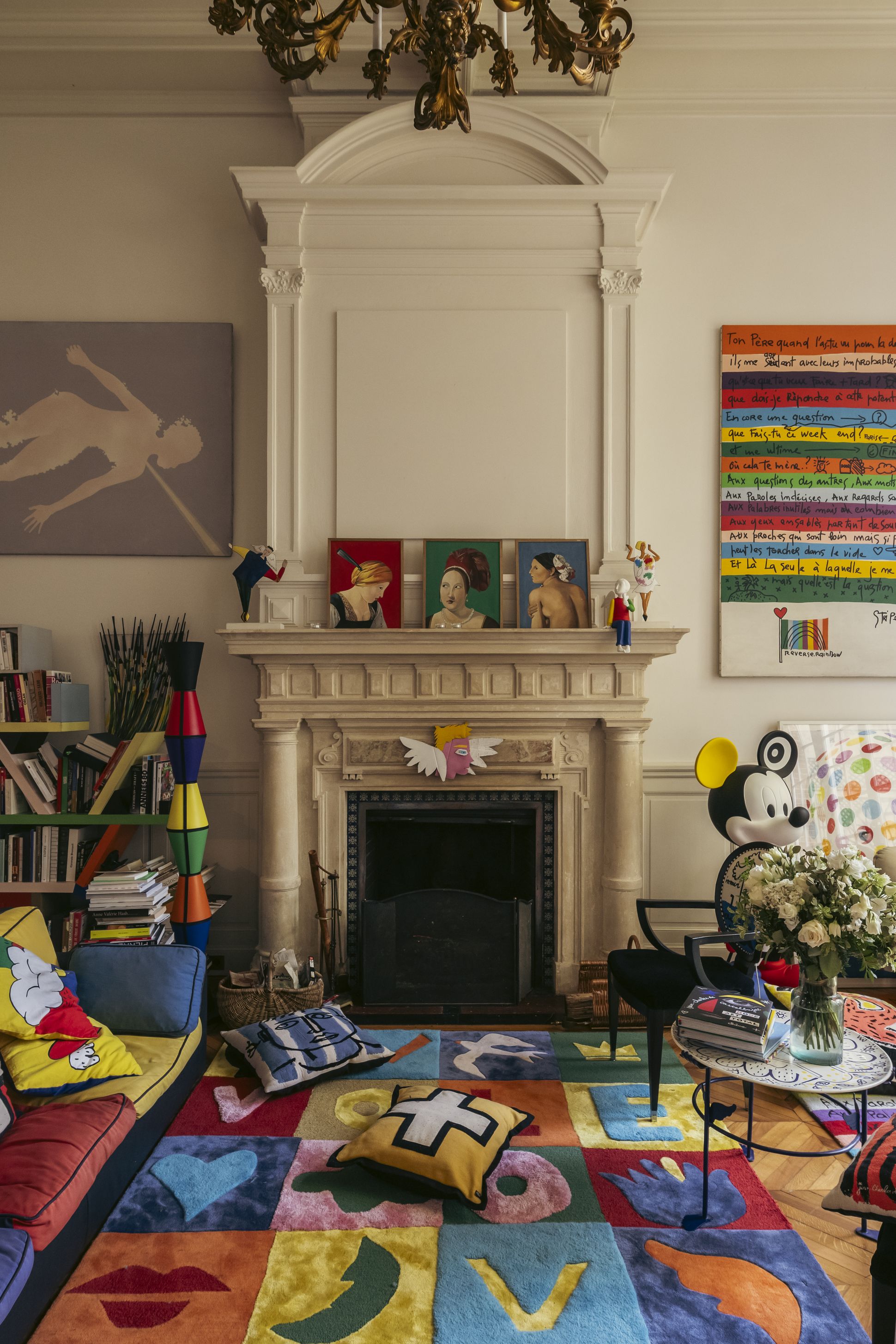
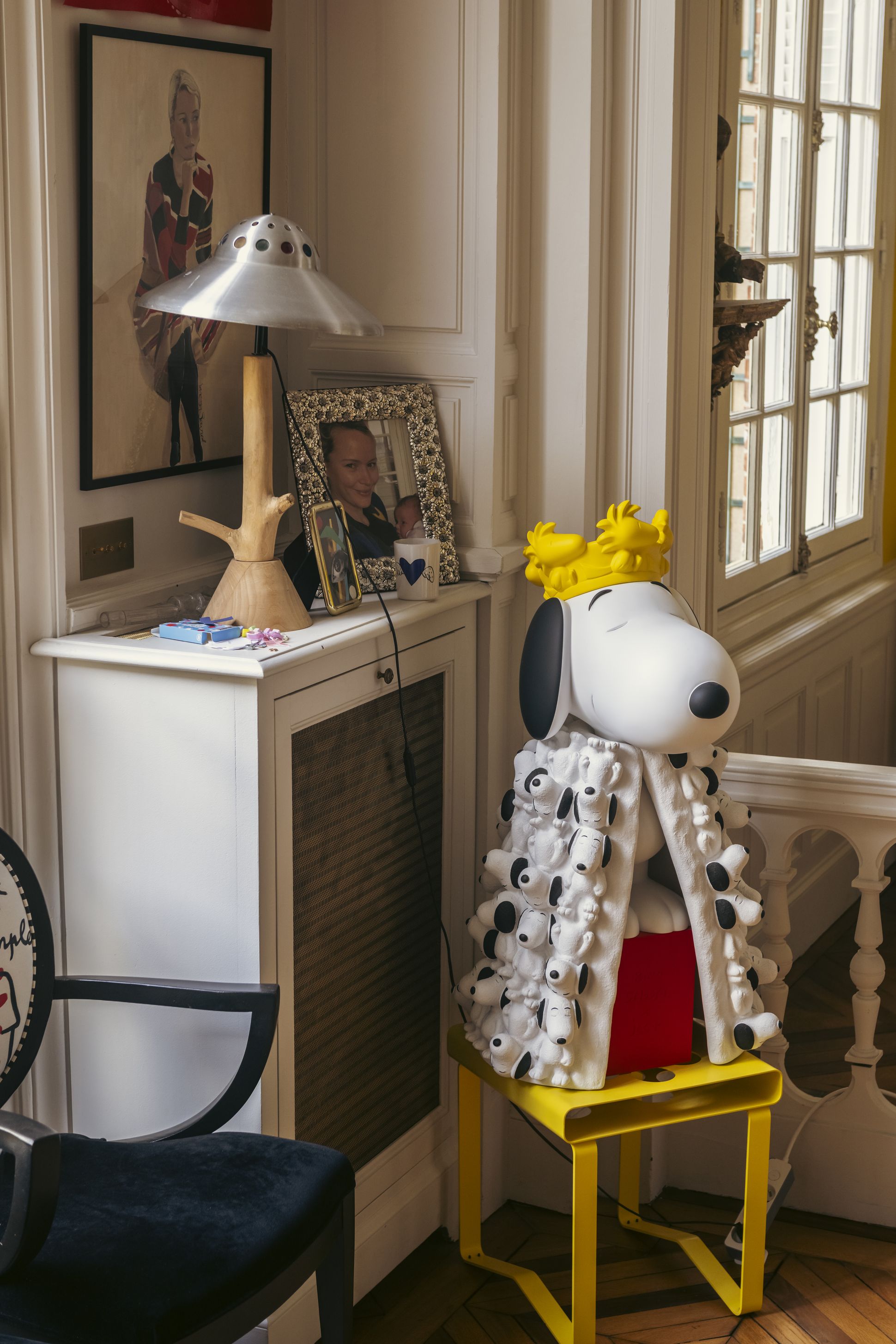
I see a house, an apartment, as a kind of stage facing an empty theatre, with no audience. So I create a setting, and then a memory comes back to me, and I rearrange the space, giving things a new place.
TSF
Is there an object that has followed you from one home to another throughout your life?
Jean-Charles de Castelbajac
There are quite a few. First of all, there's a little portrait that I love more than anything. It's a photograph of Alice Liddell, taken in the nineteenth century by Lewis Carroll — Alice from Alice's Adventures in Wonderland — with her little sister. They're both dressed as Chinese girls.
I acquired this photograph from a wonderful woman who believed in photography back in the 1970s, when hardly anyone else did. Her name was Daniela Palazzoli.
TSF
And colour, which plays such an essential role in your world: what has your relationship with it been like?
Jean-Charles de Castelbajac
For the first ten years, from 1970 to 1980, I worked exclusively with beige, brown and off-white tones. They carried the scent of the countryside, because I had this deeply rooted, almost visceral connection to the earth and to minerals. I was living near Limoges.
I remember that when I started enjoying considerable success, very early on, with Créateurs et Industriels, People Magazine came over from the United States to do a feature on me. I posed with a sheep draped over my shoulders, standing in the middle of the fields. They were astonished in the US, because everything there was about glamour. And there I was, in my boots, surrounded by sheep.
That was my world for ten years. During that period, I also compiled an inventory of materials that were on the verge of disappearing — and which have now all disappeared.
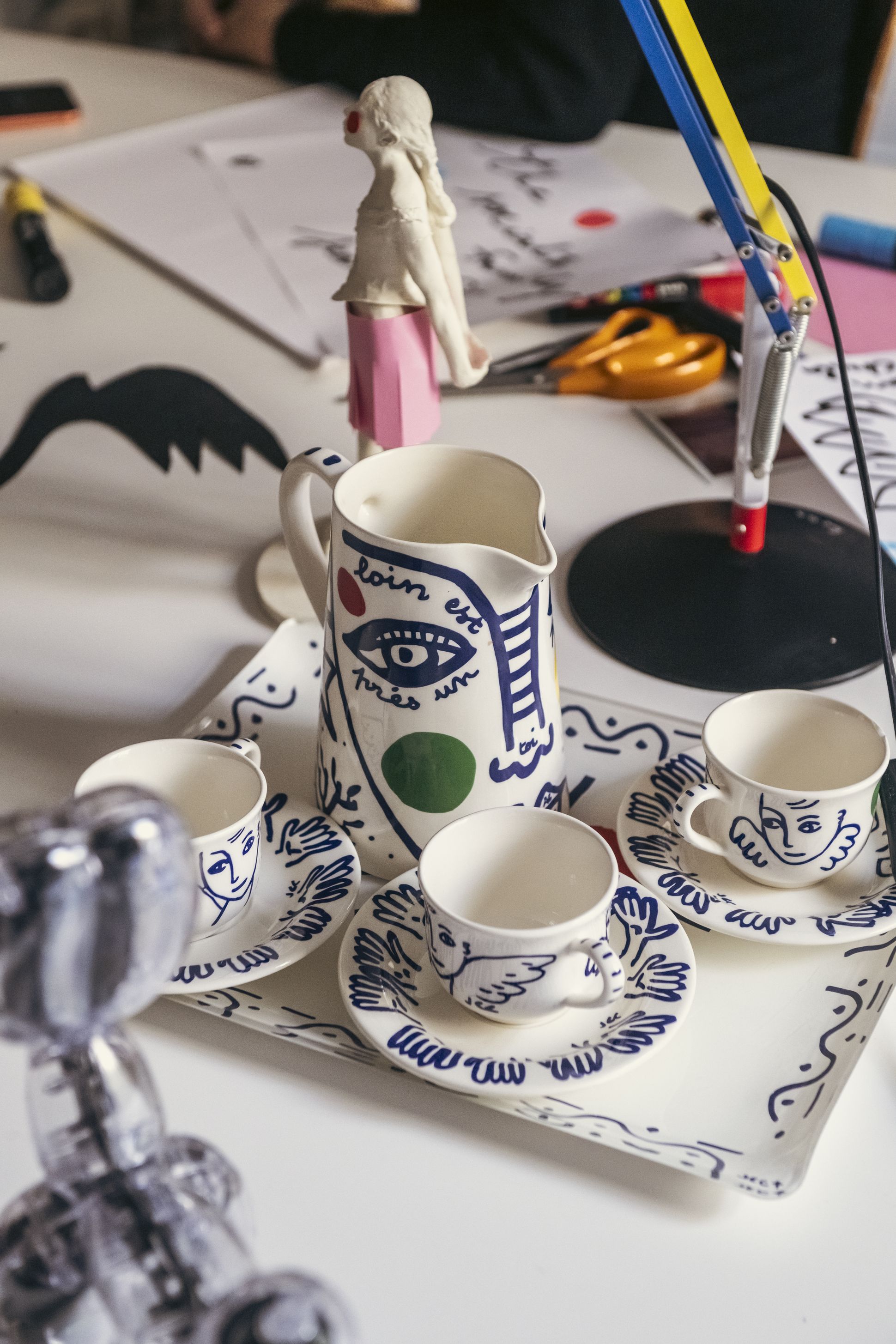
Then, in 1980, colour really entered my life through my encounter with Pop Art, comic books and great illustrators. At a certain point, I began appropriating all kinds of icons, slogans, Raymond Loewy's logos and cartoon characters, enlarging them to create banners on knitted sweaters and silk dresses.
These designs would later become the foundations of streetwear. They were an enormous popular success.
TSF
You have a deep connection with the world of childhood...
Jean-Charles de Castelbajac
I believe that even on the day I take my final breath, I will still be a child at heart. That's why I have such a special relationship with children and animals. There's an invisible dialogue, a kind of unspoken bond between us. It's probably what explains why my exhibition Le Peuple de Demain attracted 150,000 visitors to the Children's Gallery at the Centre Pompidou.
TSF
What does a typical day in your life look like?
Jean-Charles de Castelbajac
You know, what makes me a happy and free man today is still this appreciation of the simple, beautiful things that life has to offer.
I take my daughter to school, walk my dog, and pop down to the end of the street to do some shopping. Then I wander around. I always carry chalk in my pocket, so I draw angels wherever I go.
Street art opened the door to some extraordinary encounters, with André, Lek & Sowat and other street artists. It inspired me to create sculptures in the city, to work with light and shadows, and to draw quickly, because you're standing with your back to the street. And above all, it gave me the opportunity to meet people. That's what really touches me.
Then I go to my appointments, often by metro or taxi, and make my way home on foot. After that, Pauline, my wife, and I work together and look at our various projects.
I draw all the time. I draw because it's a form of emotional exercise. Then I read Les Inrockuptibles or NME. I draw all the time. I draw because it's a form of emotional exercise. Then I read Les Inrockuptibles or NME. I browse through Instagram, go to exhibition openings or concerts, and read adventure and historical novels.
TSF
Does music still inspire you?
Jean-Charles de Castelbajac
It's my elixir of youth. It always has been…
When I first heard Jacno in 1980, I immediately wanted to meet him. There was Elli Medeiros, who is still a friend of mine today. That's how it all began.
I love discovering emerging artists, particularly alternative bands such as Sleaford Mods, Oklou, Westside Cowboy and Lazy Eyes. Sometimes, I even invite them to collaborate on a stage design.
Music has always been that binding force, that thread running through everything. It takes me somewhere else, opens up new horizons and inspires me.
TSF
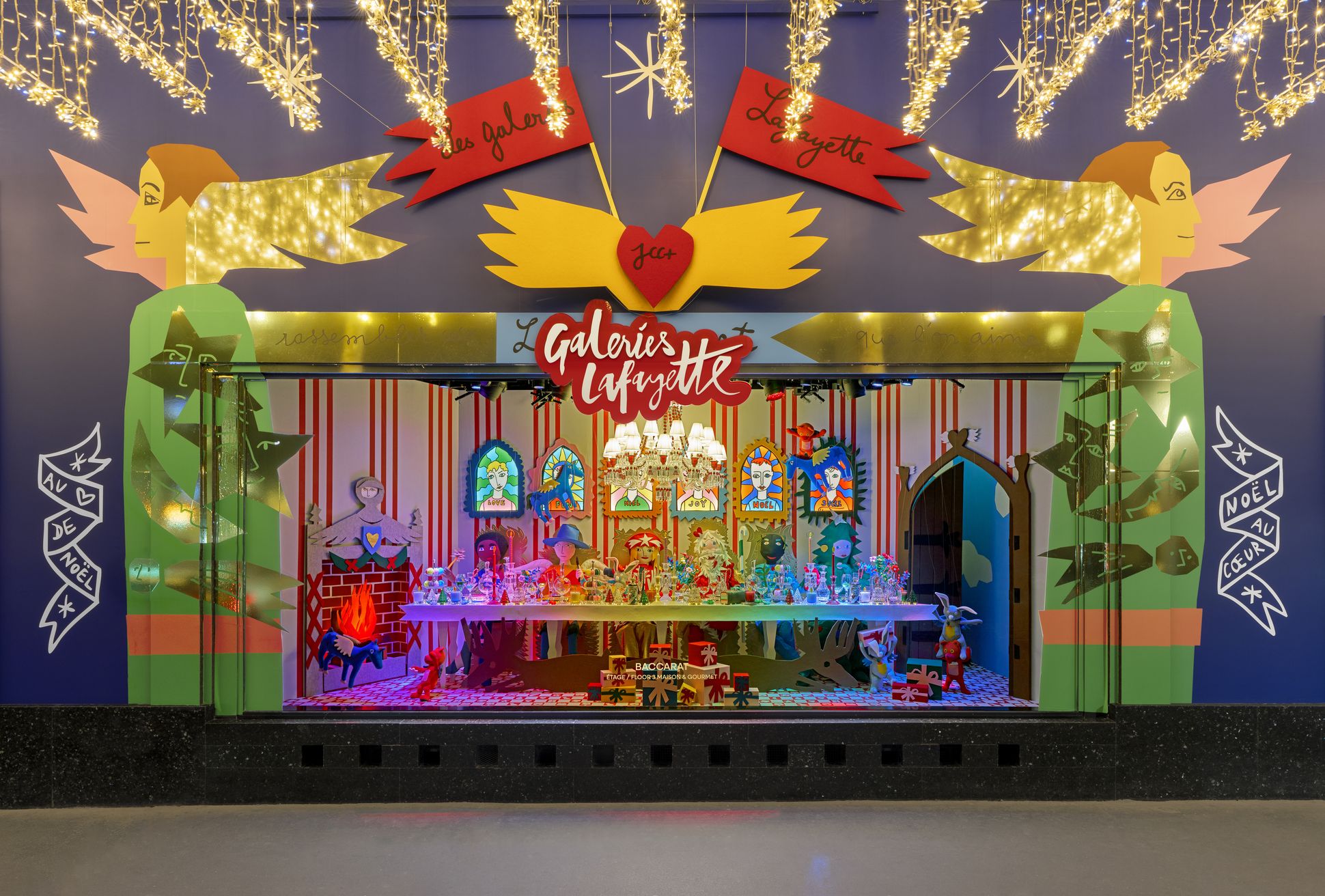
We're here in your home, and there's something called a diorama — a miniature world recreated inside a display case. You've just designed the Christmas window displays for Galeries Lafayette. Could you tell us a little about them?
Jean-Charles de Castelbajac
It's an ode to fraternity and togetherness.
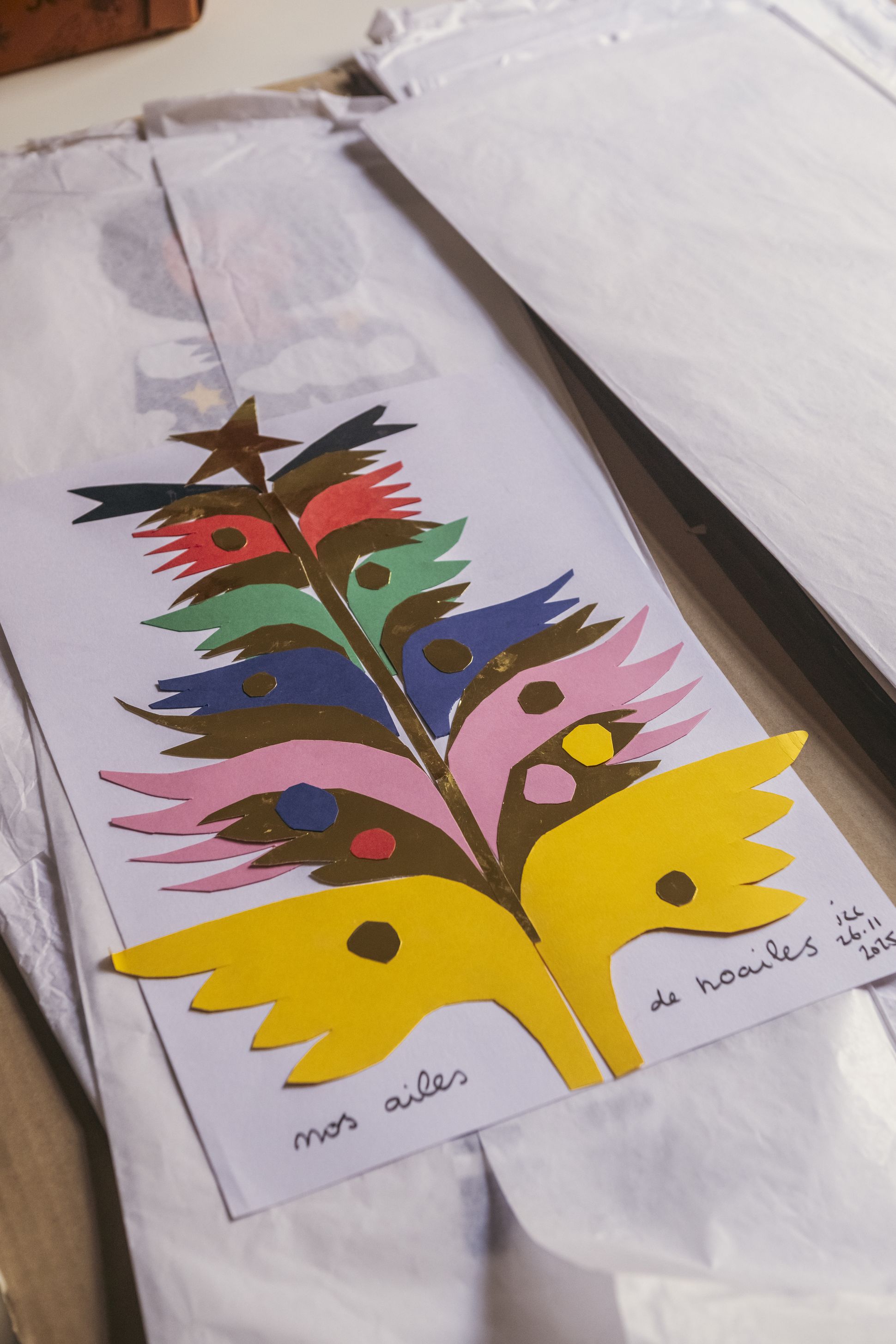
I had this idea of creating all the window displays using scissors as my main tool: cutting things out and taking Galeries Lafayette on a journey where artificial intelligence could take a holiday.
Guillaume Houzé, the Image Director at Galeries Lafayette, immediately embraced the idea.
The window displays were built by Nathalie Bournillat's workshops, just outside Paris, while the teams at Adada brought all my characters to life, crafting them from felt and natural materials.
For me, the process involved creating one collage a week, each corresponding to a different window, and then bringing it to life with the wonderful teams at Galeries Lafayette.
As usual, I didn't work from a mood board or a pre-written storyline. Everything came to me intuitively.
I tell the stories of twelve magical characters from my imagination. One of the windows explores my relationship with music. Another is about our relationship with one another, told through the setting of a grand dinner.
I love Christmas gatherings around a big table, when everyone comes together, even those who live far away. We reunite, and our souls embrace. There's something incredibly moving and intimate about that.
The musical soundtrack accompanying this adventure is an electro version of The Nutcracker, created by musician Vladimir Cauchemar.
TSF
You were also given a wonderful carte blanche for the interior of the store...
Jean-Charles de Castelbajac
Inside the store, I also created all the playlists and designed this rather unusual Christmas tree. I'm not an interior decorator, after all. I wasn't going to simply bring in a traditional Christmas tree and decorate it with oversized ribbons or baubles.
I wanted wings. I wanted to convey a sense of protection, to bring in colour, grace, joy and love.
Alongside the publication of my monograph, this is probably the finest expression of a complete artistic achievement. As a fashion designer, I've created an entire clothing collection for Galeries Lafayette. As a scenographer, I've designed the window displays. And as a curator, I've invited Elsa Muse to create the animations, Charlotte Abramow to take the photographs, and Vanessa Pinto, along with many other brilliant young artists, to contribute to the project.
My inspiration also comes from people themselves, from the public, and from sharing with them the joy and wonder of Christmas as they stand in front of the window displays.
TSF
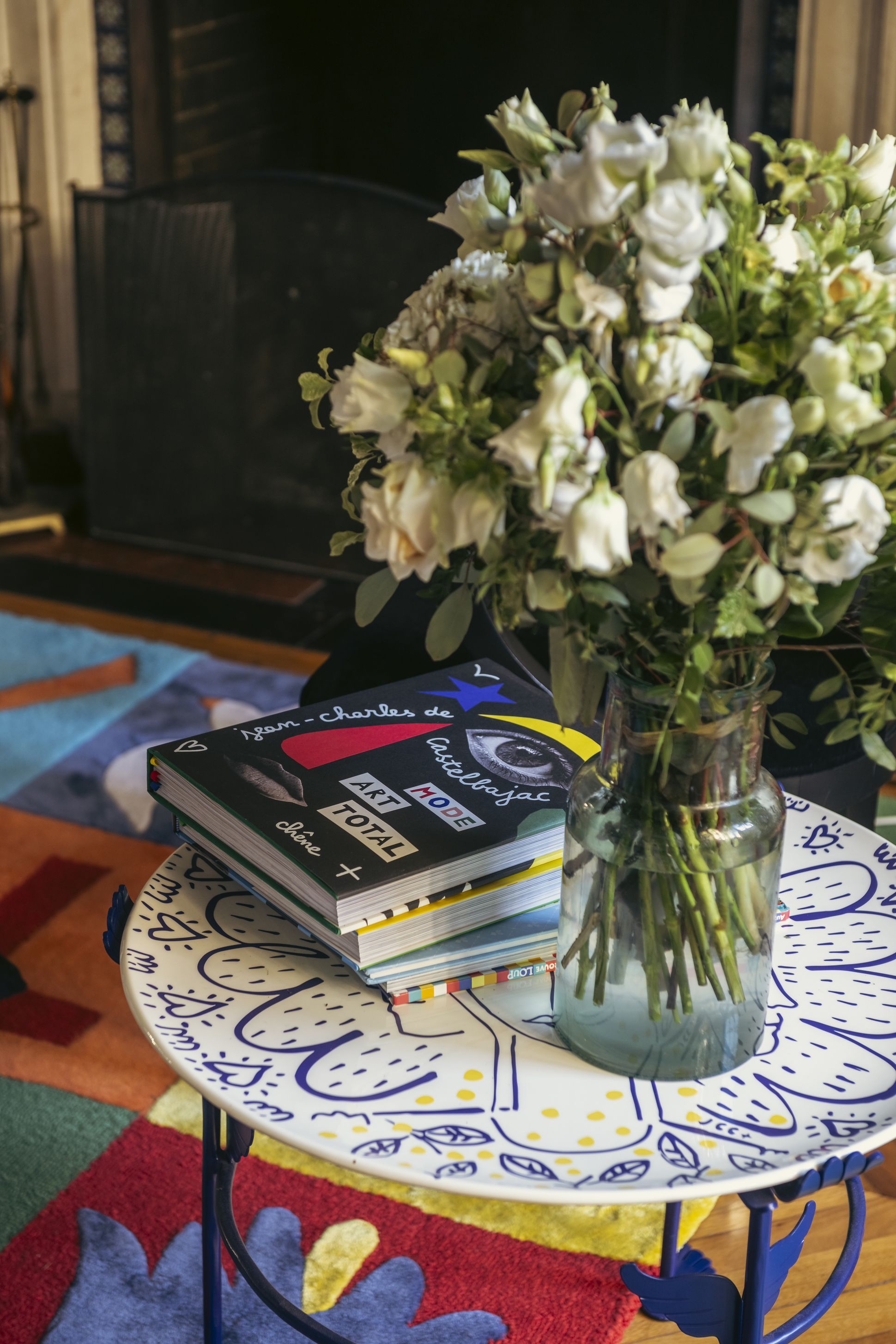
Following the major retrospective dedicated to you at Les Abattoirs in Toulouse, your first monograph is soon to be published in French by Éditions du Chêne. A double honour, and a wonderful Christmas gift to give — or treat yourself to — for a generous dose of inspiration. What does this book mean to you, and what did you hope to convey through its pages?
Jean-Charles de Castelbajac
It tells the story of the ability to both create and communicate, to master a craft and share that knowledge with others. I think it can also be a wonderful tool for passing things on and making art accessible.
I'm beginning to realise, you see, that Generation Z doesn't know I was a punk, or that I worked with Lady Gaga and Ed Banger. So, when you've had such a long career, you have to know how to reinvent yourself, and that's exactly what this book reveals.
TSF
And what would your dream project be today — something you haven't yet dared to imagine or bring to life?
Jean-Charles de Castelbajac
This project has actually made me want to create a new space. I've always loved concept stores, because they gave me the opportunity to invite other artists to take part. I've invited Tom Sachs, Jeremy Scott, Space Invader and André, for example.
What I'm missing is a place where I can connect directly with the public. A pop-up space, like the one I have at Galeries Lafayette for two months, where people could discover my whirlwind displays of postcards, collages made from old cardboard, my Barbie, my blanket coats, my collection for Rossignol, and my tableware for the Faïencerie de Gien.
I'd like to create a kind of bazaar — a big Castelbazar, if you like.
That would make me very happy.